
EPOXY FLOORING SYSTEM FOR LABORATORIES WITH LIGHT CHEMICAL USE
Introduction
Laboratories with light chemical exposure require flooring systems that provide chemical resistance, hygiene, and mechanical strength while maintaining a smooth, easily cleanable finish. Although the chemical exposure is moderate, regular contact with reagents, solvents, and cleaning agents demands a protective floor with long-term reliability and resistance.
The Ressi EPO System – Chem Might from Ressichem combines reliable primers, self-levelling underlayment (if needed), and a high-performance chemically resistant epoxy topcoat. This system ensures lasting durability, cleanability, and chemical protection ideal for controlled laboratory environments.
Recommended Use Cases
- Educational and institutional laboratories
- Pharmaceutical and analytical QC labs
- Light chemical handling rooms
- Research and development areas
- Diagnostic and product testing laboratories
- Cleanrooms and sample preparation zones
Step-Wise System Description
Step 1: Surface Preparation
- A well-prepared substrate ensures strong adhesion and system longevity.
- Begin with a sound, levelled screed
- Mechanically grind or lightly shot blast the surface to remove laitance, dust, and contamination.
- Clean thoroughly to remove oil, grease, and other residues.
- Fill cracks and voids with an epoxy-based repair mortar. All damages should be repaired using suitable repairing materials. Ressichem has a wide variety of repairing materials available.
- Confirm that the substrate moisture content is below 5% before proceeding.
Step 2: Application of Ressi SLS Primer – 1 (if Required)
- Where levelling is required, apply Ressi SLS Primer – 1, a latex-based primer that enhances adhesion between the substrate and the self-levelling compound.
- Stir thoroughly before use.
- Apply uniformly by roller, brush, or spray.
- Avoid puddling and allow to dry to a tack-free finish (approximately 2–4 hours).
Step 3: Application of Ressi SLS 610 Self-Levelling Screed (if Required)
- If the substrate requires correction or levelling, apply Ressi SLS 610, a self-levelling cementitious screed.
- Mix with clean water per manufacturer’s recommendations using a low-speed mixer.
- Pour and spread evenly using a gauge rake or trowel.
- Use a spiked roller to release entrapped air and achieve a smooth finish.
- Ressi SLS 610 does not require curing, but it must be allowed 7–14 days for moisture release depending on ambient conditions.
- Proceed with epoxy application only once the moisture content is verified below 5%.
Step 4: Application of Ressi EPO Primer LV
- Once the surface is fully dry and stabilized, apply Ressi EPO Primer LV, a low-viscosity, solvent-free epoxy primer that penetrates and seals the substrate for improved adhesion.
- Mix resin and hardener thoroughly according to the specified ratio.
- Apply uniformly using a roller or brush.
- Avoid puddles and ensure complete coverage.
- Allow the primer to cure overnight before applying the epoxy topcoat.
Step 5: Application of Ressi EPO Chem Might
- The final coat consists of Ressi EPO Chem Might, a high-build, solvent-free epoxy coating designed to deliver chemical resistance and surface durability under light laboratory conditions.
- Mix both components thoroughly using a low-speed drill.
- Apply evenly using a roller or squeegee, ensuring consistent coverage.
- Apply in a single layer at a minimum total thickness of 1000 microns.
- Allow 48–72 hours before opening for mild traffic, depending on ambient temperature.
- Allow a full cure of 7 days before subjecting the floor to chemical exposure or routine use.
- This results in a seamless, dense, and chemical-resistant floor capable of withstanding mild acids, alkalis, and solvents.
System Advantages
- Chemical Resistance: Protects against mild acids, alkalis, and solvents.
- Durability: Resists abrasion and light mechanical stress.
- Hygienic & Seamless: Non-porous, easy to clean, and prevents microbial buildup.
- Single-Coat Efficiency: Achieves protection at ≥ 1000 microns.
- Controlled Cure Schedule: Ready for mild traffic in 48–72 hours; full cure in 7 days.
- Professional Finish: Smooth, semi-gloss appearance ideal for laboratories.
Maintenance Guidelines
- Clean regularly with neutral pH, non-abrasive detergents.
- Avoid strong acids or solvent cleaners.
- Promptly clean chemical spills.
- Inspect the surface periodically and recoat if required to maintain chemical protection.
System Parameters
| Parameter | Description |
|---|---|
| System Name | Epoxy Flooring system for Laboratories with light chemical use. |
| Area Type | Laboratories with Light Chemical Use |
| Traffic Exposure | Light to Medium Duty |
| Primary Requirements | Chemical Resistance, Hygiene, Durability |
| Optional Layers | Ressi SLS Primer – 1, Ressi SLS 610 (if required) |
| Primer | Ressi EPO Primer LV |
| Topcoat | Ressi EPO Chem Might |
| Total System Thickness | Minimum 1000 Microns (Single Layer) |
| Finish Type | Smooth, Semi-Gloss |
| Curing Time Before Use | 48–72 Hours for Mild Traffic / 7 Days Full Cure |
| Key Benefits | Chemically Resistant, Durable, Hygienic, Seamless |
Conclusion
For laboratories with light chemical use, the Ressi EPO System – Chem Might offers a durable and hygienic flooring solution that balances chemical resistance and functionality. The system — Surface Preparation, Ressi SLS Primer – 1 (if required), Ressi SLS 610 (if required), Ressi EPO Primer LV, Ressi EPO Chem Might — delivers a smooth, chemical-resistant, and long-lasting epoxy floor suited to laboratory environments requiring reliability and cleanability.
System Summary
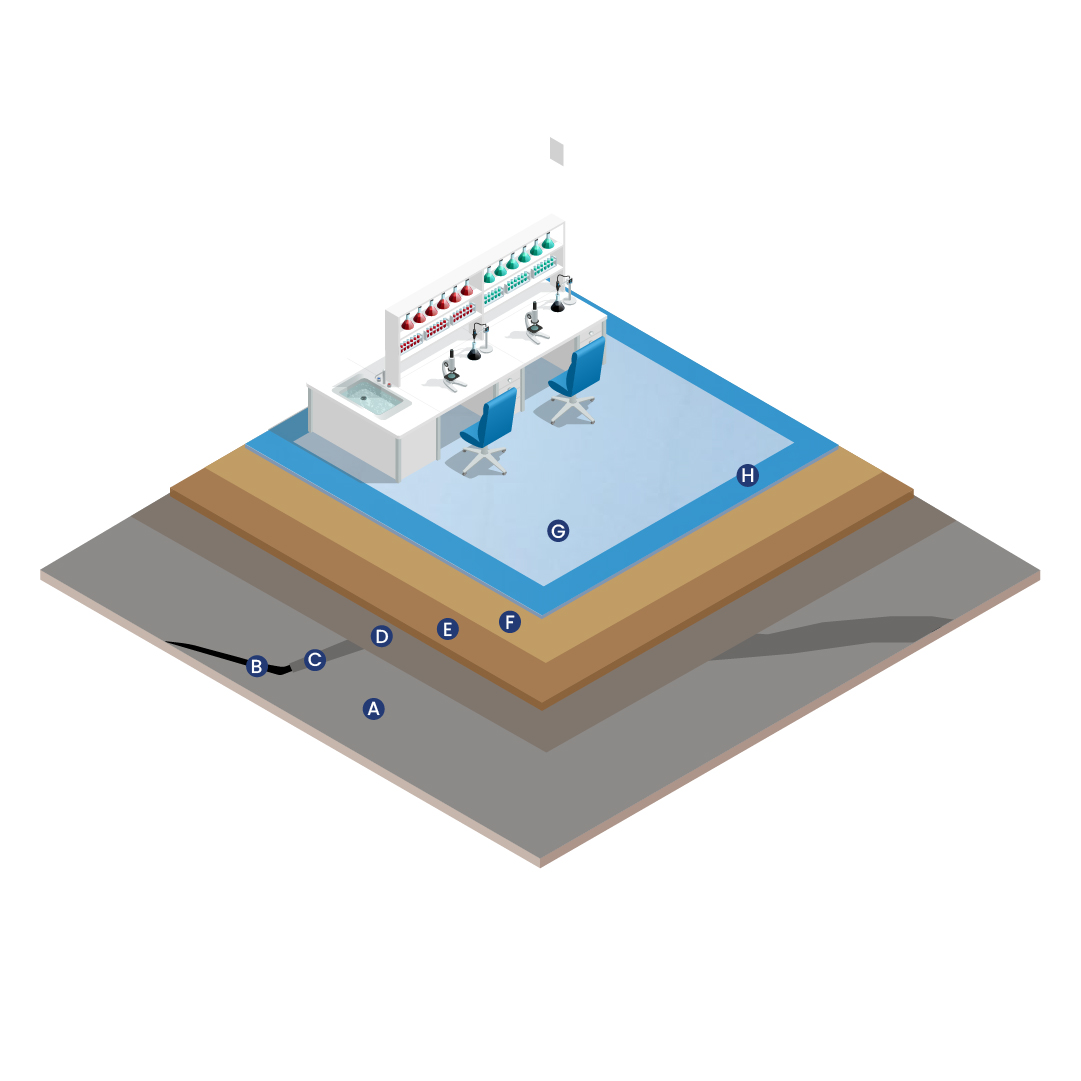
A. Cementitious Surface: (Concrete slab or screed)
B. Cracks and surface damage
C. Crack Filler and Repairing Materials
D. Ressi SLS Primer - 1 (Optional)
E. Ressi SLS 610 (Optional)
F. Ressi EPO Primer LV
G. Ressi EPO Chem Might
H. Ressi EPO Chem Might (Marking)